There’s a scene in The Bear where Carmen stands over a burner, making dish after dish in a small carbon steel pan, hundreds of times, until the motion becomes automatic. It’s not dramatic. Nobody applauds. The point is that perfection, whether a silky French roll or a glossy Japanese omurice, doesn’t come from inspiration. It comes from repetition, and from having a pan that cooperates.
If yours fights you, you already know. The egg catches. The fold tears. The whole thing goes sideways in the last five seconds.
The right omelette pan fixes most of that before you crack an egg.
Why the Pan Is Actually the Point
A knife can be sharpened. Butter temperature is adjustable. But a pan with the wrong surface, wrong weight, or wrong slope will undermine a French omelette every single time, because the technique gives you almost no room for error. You’re working in under ninety seconds. You’re using low-to-medium heat. You need the egg to move freely, the sides to roll without sticking, and the rim to be curved enough that the fold happens in one clean motion.
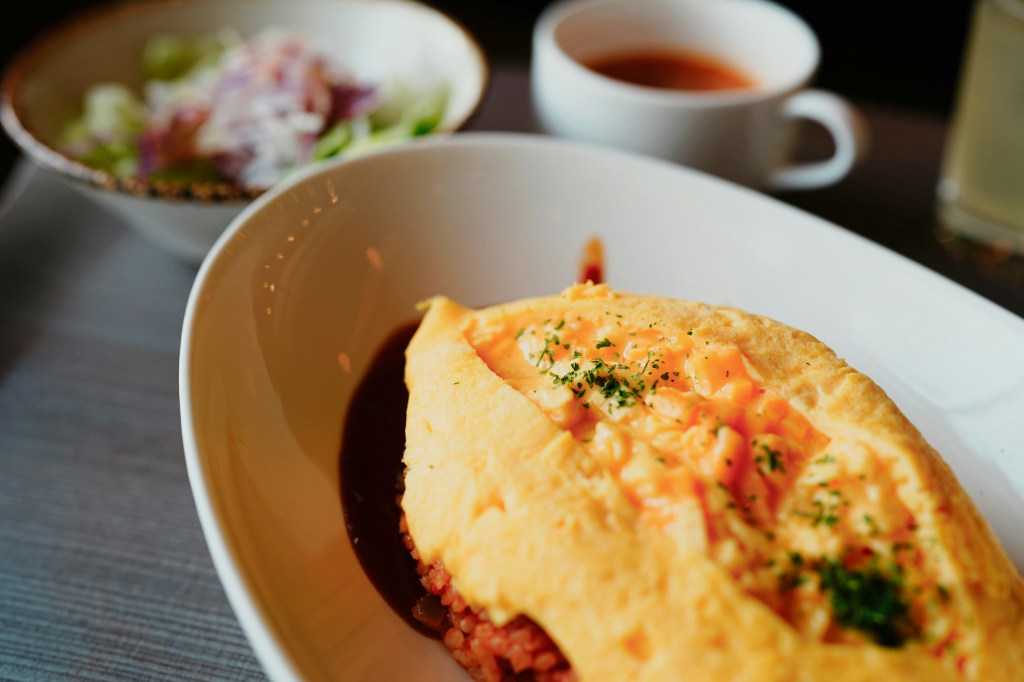
The French omelette, which is pale and barely set and looks almost too simple, is one of the most technique-dependent things you can make for brunch. The Japanese omurice, built around fried rice wrapped in a thin golden sheet of egg, requires a different rhythm but the same fundamental relationship with the pan: nonstick, responsive, forgiving.
Both dishes reward a pan chosen with some care.
What Actually Matters When Buying
Surface and Release
This is everything. For omelettes specifically, you need either a well-seasoned carbon steel or a quality nonstick coating, because the egg must slide. Cast iron runs too hot and holds heat too aggressively. Stainless will punish you unless you’ve temped it precisely. For most cooks, a nonstick coating or carbon steel is the honest answer.
Size and Slope
An 8-inch pan is the standard for a two-egg omelette, and the sloped sides aren’t decorative. They’re structural. The angle lets you fold and roll without a spatula, using just the pan’s momentum. A straight-sided skillet forces you to work against the geometry.
Weight and Heat Distribution
Light pans heat quickly but spike unevenly. Heavy pans are slow to respond. You want something in the middle: enough mass to hold steady heat, light enough to tilt and maneuver one-handed. This is why the cheap options often fail at the moment that matters.
Handle Angle and Grip
This sounds minor until you’re holding the pan at a forty-five-degree angle over the plate and your grip slips. A handle that angles slightly upward, with some texture, is a real-world feature. Long handles give more leverage; short ones fit in drawer storage.
The Picks
Best Overall: Mauviel M’Steel Carbon Steel Omelette Pan
This is the pan Carmen would use, and the one that rewards practice. Carbon steel heats fast, seasons beautifully over time, and becomes genuinely nonstick after a handful of uses if you treat it right. The sloped sides on the Mauviel are well-proportioned, and the handle angle feels correct when you’re doing the fold. It’s lighter than cast iron, heavier than cheap nonstick, and will outlast both. The only real caveat: the first few uses require patience and fat. It’s not nonstick out of the box. Give it three sessions and you’ll understand why professional kitchens use it.
8″ | carbon steel | mid price tier
Best Value: Nordic Ware Restaurant Omelette Pan
For the cook who wants to practice the technique before committing to carbon steel, this delivers. The nonstick surface is more durable than pans at this price usually are, the slope is correct, and the weight is manageable. It won’t last twenty years, but it will teach you how an omelette is supposed to feel when it’s going right. Worth having as a dedicated egg pan.
8″ | nonstick aluminum | entry price tier
Best for Serious Cooks: de Buyer Mineral B Omelette Pan
If you’ve watched enough Jacques Pépin and decided you’re committed, this is the pan. The de Buyer Mineral B is thicker than the Mauviel, seasons to a near-black patina that releases eggs like glass, and has a heft that makes you slow down and cook more deliberately. The handle is long and riveted, with a slight upward curve that feels right. French omelette, Japanese rolled omelette, omurice, eggs en cocotte lifted out at an angle: this pan handles all of it with quiet authority.
8″ | carbon steel | premium price tier
Comparison Table
| Product | Price Range | Best For | Key Feature | Rating (/5) |
|---|---|---|---|---|
| Mauviel M’Steel Carbon Steel | Mid | Most home cooks | Fast heat response, durable seasoning | 4.7 |
| Nordic Ware Restaurant Pan | Entry | Beginners and practice | Reliable nonstick, correct slope | 4.1 |
| de Buyer Mineral B | Premium | Committed technique cooks | Dense carbon steel, exceptional patina | 4.9 |
The Verdict
If you make omelettes more than twice a month and want to actually improve, buy the Mauviel M’Steel. It’s the right balance of performance and commitment. If you’re just starting out or want something low-maintenance, the Nordic Ware earns its place at the price. And if you already know what you’re doing and want a pan that will be better in ten years than it is today, the de Buyer Mineral B is the one you keep.
The omelette is the thing you make on Sunday mornings when nobody’s watching. It’s also the dish chefs use to evaluate each other, because there’s nowhere to hide. A good pan won’t make you Carmen. But a bad one will stop you from ever finding out how close you could get. Buy the right one and start the repetitions.

 Synnova Atelier
Leave a comment