There is a ceviche tostada at Holbox in Los Angeles, inside Grand Central Market, that stops most people mid-sentence. The fish is clean, the sauce is sharp, and then there is uni, a small golden lobe of it, resting on top like an afterthought that turns out to be the whole point. You eat it and the ceviche becomes something else entirely: richer, deeper, with a sweetness that lingers well past the acid. It is one of those bites that makes you understand, without explanation, why certain ingredients are worth the fuss.
That is the promise of uni. Not ornamentation, not theater, but a quiet transformation of whatever it touches.
What Uni Actually Is
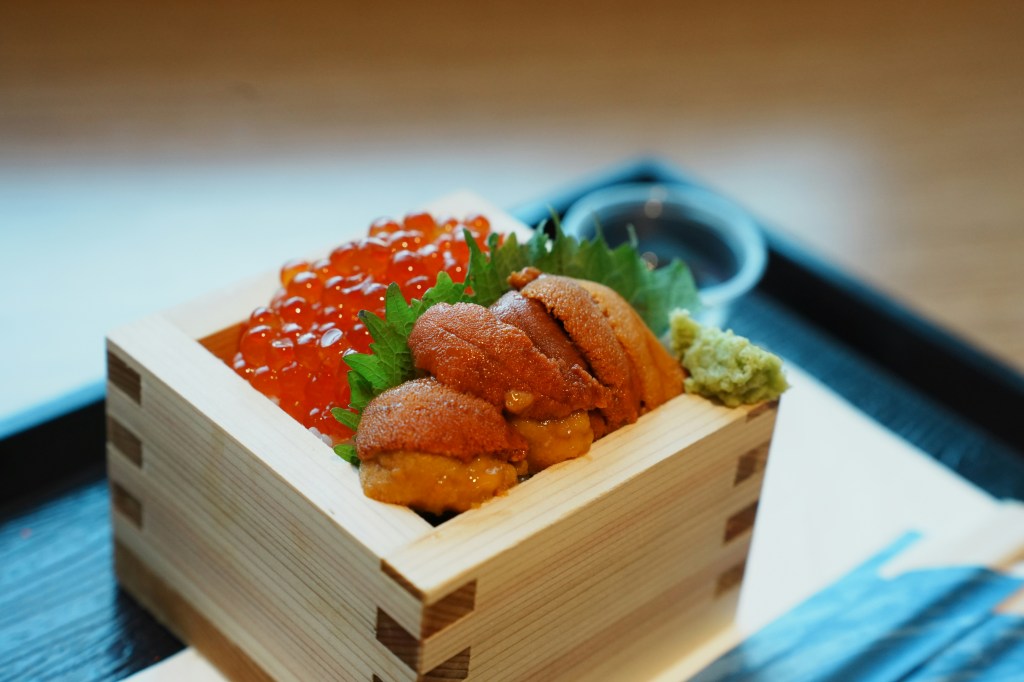
Uni is the roe of the sea urchin, specifically the reproductive organs, though calling it roe is a loose translation. What you are eating is five tongues of soft, briny, custard-like flesh from inside a spined shell. The flavor is oceanic without being fishy, sweet without being cloying, and rich in a way that fat alone cannot explain. It finishes with something the Japanese call
umami at a register you rarely find elsewhere in seafood.
The two species you will most commonly encounter are Santa Barbara uni, harvested from California’s Channel Islands and prized for its pale gold color and sweetness, and
Hokkaido uni from northern Japan, which tends toward a deeper amber, more complex, with a longer finish. Both are legitimate. What you want to avoid, in any species, is anything with a grey tint, a pooled liquid base, or a smell that reads as ammonia rather than sea air.
Uni has been foundational to Japanese cuisine, specifically to sushi and kaiseki, for centuries. Its recent momentum in mainstream American cooking is less trend than correction: chefs who trained in Japan or who spent time eating seriously there have been quietly weaving it into their menus for years. Holbox’s ceviche is one example. You will find it on pasta at Italian restaurants in New York, folded into butter for a steak sauce in Chicago, tucked into tacos along the California coast.
How to Handle It
Uni does not want heat, at least not much of it. The proteins are delicate and the sugars volatile. Apply direct sustained heat and you are left with something grainy and flat, the opposite of what you paid for.
The technique, almost universally, is to use uni as a finishing element or to incorporate it into a warm base off the heat. If you are making a pasta sauce, cook your shallots and white wine to near-reduction, pull the pan from the flame, add a knob of butter, and then push the uni in. Stir slowly. The residual heat is enough to melt it into the sauce without cooking it through. It should look emulsified, not scrambled.
For raw applications, the cues are all about temperature and pairing. Uni from the refrigerator, served cold on warm rice or a cool cracker, reads differently than uni left to sit at room temperature for twenty minutes, where its sweetness opens up. Neither is wrong. Know what you want from it.
The most common mistake is treating uni like a condiment, a small smear of something expensive applied for status rather than function. Uni works when it is integrated. It is not a garnish. It wants to dissolve into things, to become the background note you cannot identify but cannot stop tasting. Use enough of it that it reads in every bite.
Three Places to Use It
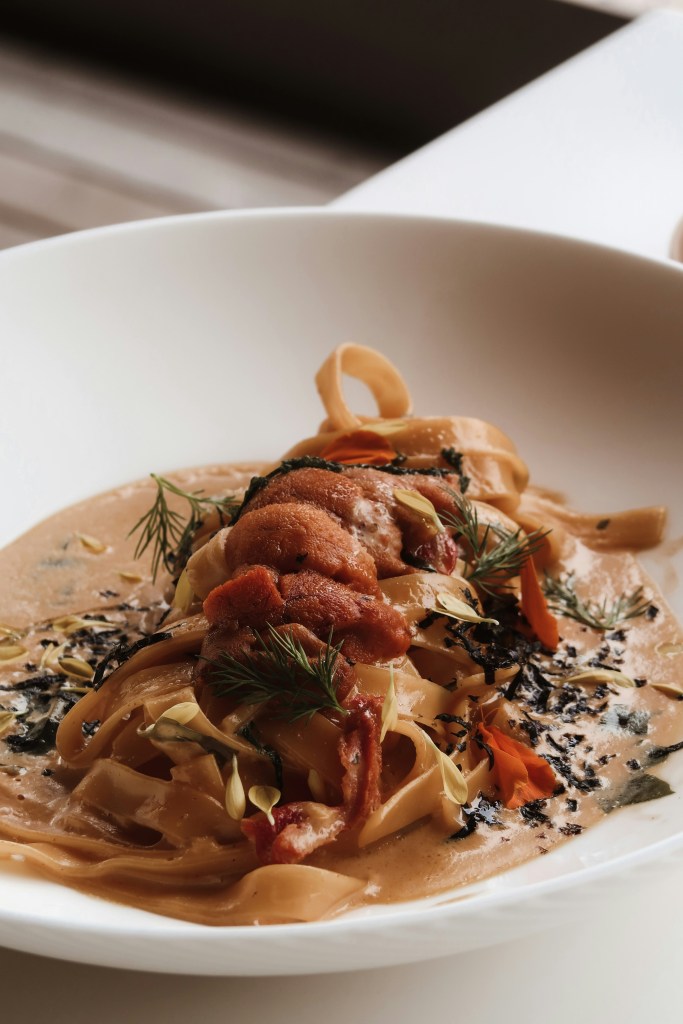
Uni Butter Pasta
This is the entry point and, for most people, the conversion. Cook your pasta two minutes short of done, finish it in a wide pan with pasta water and a little white wine. Off the heat, add cold butter in pieces, then uni. Stir until glossy. The uni melts into the emulsion and what you have is a sauce that tastes like the sea rendered in silk. Bottarga shaved over the top if you have it. A little chili if you want the contrast.
Uni on Scrambled Eggs
This sounds simple because it is. Soft-scrambled eggs, cooked low and slow in butter, finished off the heat so they are barely set. Spoon uni directly on top and eat immediately. What happens is a fat-on-fat layering that is richer than either ingredient alone, with the egg providing the neutral canvas the uni needs to be itself. A few flakes of good sea salt. That is the whole recipe.
Uni Ceviche (The Holbox Method)
The fish (halibut or sea bass, cut small) cures briefly in citrus, maybe fifteen minutes, until just opaque at the edges. Make your leche de tigre sharp and cold. Plate the fish, pour the tiger’s milk, and add uni last, right before serving. The uni should not marinate. It goes on cold, whole, and intact. The acid from the leche de tigre will begin working on it the moment it hits the bowl, and by the time the spoon arrives, there is a richness in the broth that was not there a minute before.
What to Buy and Where to Find It
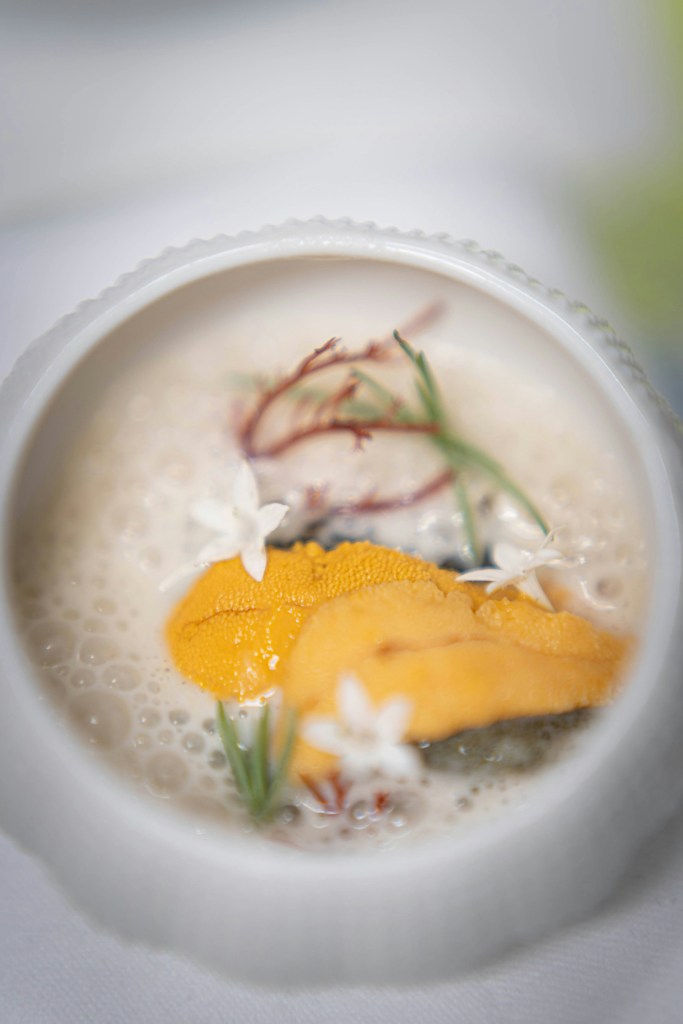
Fresh uni arrives in flat wooden trays, nestled in individual lobes. That is what you are looking for.
At the entry level, look for what most Japanese grocery stores and seafood counters carry under their house label. Quality varies but the price (typically $10-15 for a small tray) makes it the right place to start. Whole Foods and H Mart both carry it consistently in markets with strong Japanese communities.
At the mid tier, Catalina Offshore Products ships Santa Barbara uni direct, and the quality is reliably good. Their fresh trays arrive clean and properly cold-packed.
For the premium tier, Regalis Foods sources Hokkaido uni from Japan and ships it with the kind of care that gets it to your kitchen tasting like it was cut twenty minutes ago. It is expensive and worth it for the occasions when the uni is the point, not merely the accent.
One rule that holds across all price points: buy it the day you plan to use it. Uni held even a day past its prime loses the sweetness first, then the texture. There is no recovering it.

 Synnova Atelier
Leave a comment